

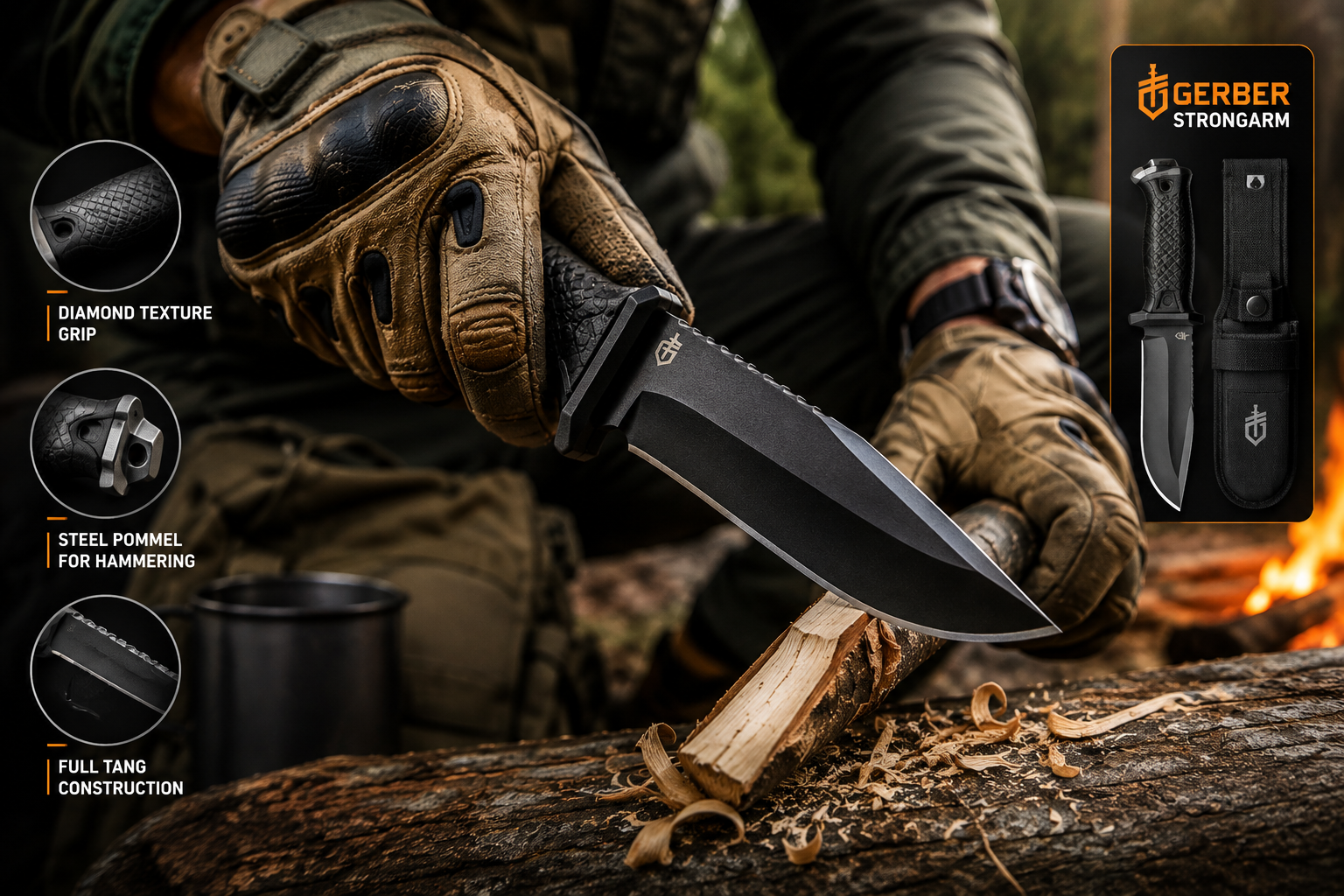
Best Camping Knife 2026: 5 Top Outdoor Knives Compared
A good camping knife doesn’t need to look like a survival movie prop. In fact, the best outdoor knife is usually the one that handles ordinary camp chores comfortably, safely, and reliably.
Think about what actually happens at a campsite. You might need to slice food, cut cord, open packaging, shave wood for a fire, carve a tent peg, prepare kindling, or perform a dozen little jobs that weren’t on your original checklist. Consequently, blade geometry, grip, corrosion resistance, weight, and ease of sharpening often matter more than flashy features.
For this 2026 comparison, we’ve focused on five well-known outdoor models that repeatedly appear in camping, bushcraft, backpacking, and outdoor-gear discussions: Morakniv Companion, Morakniv Garberg, ESEE-4, Gerber StrongArm, and Benchmade Bugout.
These knives aren’t interchangeable. The Companion is an inexpensive, lightweight general-purpose tool. The Garberg adds full-tang construction. The ESEE-4 is a heavier-duty American-made option. Meanwhile, the StrongArm emphasizes ruggedness and versatile carry, while the Bugout prioritizes extremely low weight.
Recent 2026 outdoor-knife comparisons similarly place the Companion, Garberg, ESEE-4, StrongArm and Bugout among notable choices, although their intended uses differ substantially. Outdoor Life, for example, selected the Benchmade Bugout as its lightweight winner and measured it at only 1.9 ounces.
So, which camping knife is best?
The short answer is: Morakniv Companion for everyday camp chores, Morakniv Garberg or ESEE-4 for tougher fixed-blade work, Gerber StrongArm for rugged versatility, and Benchmade Bugout when minimizing weight is the priority.
Quick Recommendation
| Category | Recommended Model | Why It Stands Out |
| 🏆 Best Overall Camp Utility | Morakniv Companion | Lightweight, simple, easy to sharpen |
| 🛠️ Best Full-Tang Value | Morakniv Garberg | Strong construction without extreme weight |
| 🪵 Best Heavy-Duty Camp Knife | ESEE-4 | Tough full-tang construction and excellent warranty |
| 🏕️ Best Rugged Versatility | Gerber StrongArm | Full tang, grippy handle and flexible sheath |
| 🎒 Best Lightweight | Benchmade Bugout | Extremely low weight and compact carry |
Important: These are editorial category recommendations, not purchasing recommendations. Local laws concerning carrying and possessing knives vary, so check the applicable rules before carrying any blade.
Camping Knife Comparison Table
| Model | Blade | Steel | Construction | Approx. Weight | Best Use |
| Morakniv Companion | 4.1″ | 12C27 stainless | Partial tang | ~3–4 oz | General camping |
| Morakniv Garberg | 4.3″ | 14C28N / carbon variants | Full tang | ~8 oz | Bushcraft |
| ESEE-4 | 4.5″ | 1095 carbon | Full tang | ~8 oz | Heavy camp work |
| Gerber StrongArm | 4.8″ | 420HC stainless | Full tang | ~10 oz | Rugged outdoor use |
| Benchmade Bugout | 3.24″ | CPM-S30V | Folding | 1.9 oz | Backpacking |
Specifications can vary by particular version, blade finish, handle material, and production configuration, so users should verify the exact model before relying on a specification.
1. Morakniv Companion — Best Everyday Camping Knife
Rating Score: 9.3/10

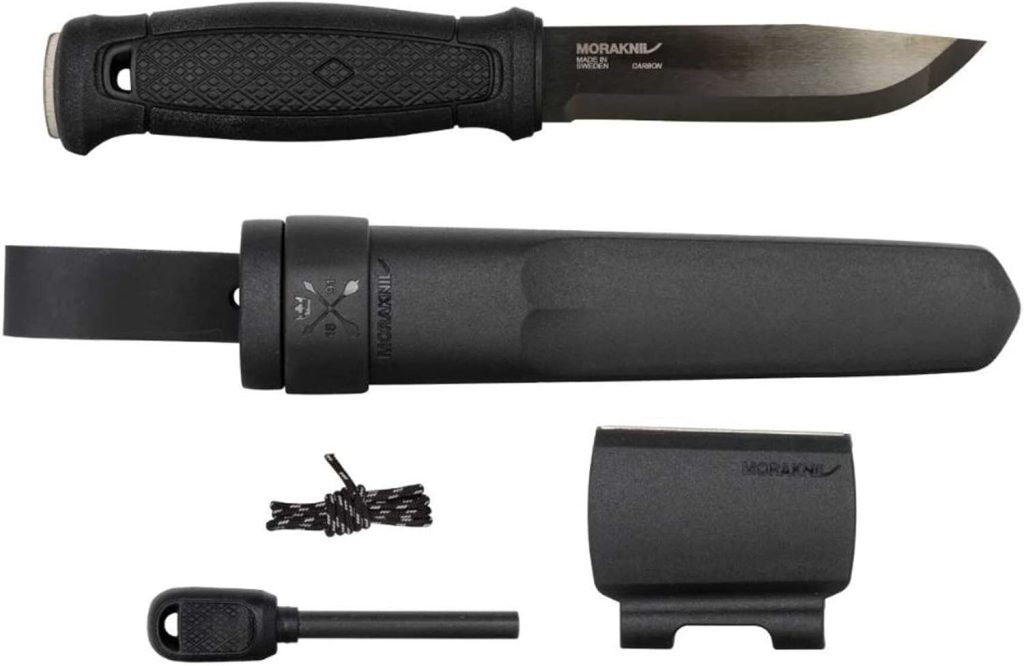
The Morakniv Companion is arguably the easiest knife in this group to understand. It isn’t trying to be an enormous survival blade, and it doesn’t need complicated mechanisms. Instead, it focuses on being light, sharp, comfortable, and useful.
The standard Companion uses a roughly 4.1-inch stainless-steel blade and a Scandinavian-style grind. Its textured handle provides substantial grip, while the molded sheath keeps the overall package compact.
That’s precisely why the Companion works so well around a campsite. Food preparation, carving, cutting cordage, opening packages, making feather sticks, and similar tasks are comfortably within its wheelhouse.
Several 2026 camping-knife guides independently highlight the Companion for value and general camp use. One recent comparison describes it as a budget all-rounder, while another rates the Companion highly for its lightweight design, stainless steel, grip, and general campsite versatility.
What Outdoor Users Like
The recurring praise is remarkably consistent: sharpness, light weight, grip, simplicity, and value.
That’s important because a camp tool doesn’t have to be expensive to be useful. The Companion demonstrates this beautifully.
However, there’s a catch. Its construction isn’t intended for extreme abuse. The partial-tang design is perfectly sensible for normal camp tasks, but it isn’t the same proposition as a full-tang heavy-duty knife.
Therefore, if your camping routine consists mostly of cooking, carving, cutting cord, and light wood preparation, the Companion makes considerable sense. If you’re planning unusually demanding wood-processing tasks, step up to a full-tang design.
Key Features
- Approximately 4.1-inch blade
- Sandvik 12C27 stainless steel
- Scandinavian grind
- High-friction handle
- Lightweight construction
- Molded polymer sheath
Pros
+ Very lightweight
+ Excellent grip
+ Easy to sharpen
+ Stainless steel resists corrosion well
+ Excellent general-purpose geometry
+ Particularly good for beginners
Cons
− Not intended for extreme abuse
− Partial-tang construction
− Basic sheath
Best suited to: General camping, food preparation, carving, hiking and everyday campsite chores.
2. Morakniv Garberg — Best Full-Tang Camping Knife
Rating Score: 9.2/10
If the Companion is the friendly everyday tool, the Morakniv Garberg is its more serious sibling.
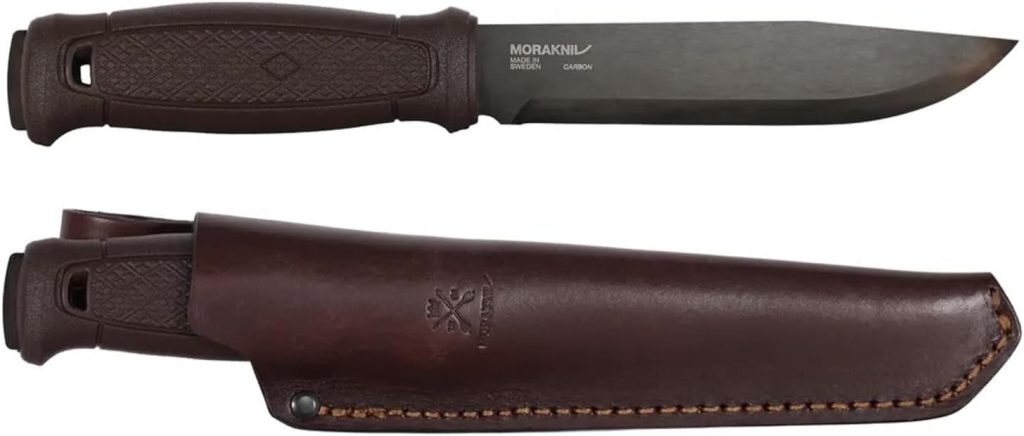
The major difference is construction. The Garberg uses a full-tang design, meaning the blade steel extends through the handle. That gives the knife a considerably more substantial platform for demanding outdoor work.
The Garberg is available in different steel configurations, including stainless and carbon-steel versions depending on the model. Recent comparisons identify the Garberg as a strong value-oriented full-tang outdoor knife, particularly for campers who want something tougher than the Companion without moving into extremely large blades.
The blade is around 4.3 inches, which is a useful middle ground. It’s long enough for many camp chores while remaining manageable for controlled cutting.
Real-World Strengths
The Garberg’s appeal is its balance. It isn’t an enormous knife that becomes annoying to carry, yet it provides the full-tang construction many experienced outdoor users prefer.
Furthermore, the Scandinavian-style edge geometry is approachable for sharpening. That’s useful on extended trips because a knife that is easy to maintain is generally more practical than one that merely holds an edge for a long time.
The downside, naturally, is that you’re carrying more weight and spending more than you would with the Companion.
In other words, the Garberg makes sense when your camping style has moved beyond occasional food preparation and into regular bushcraft-style tasks.
Key Features
- Approximately 4.3-inch blade
- Full-tang construction
- Multiple steel configurations
- Scandinavian-style grind
- Textured outdoor handle
- Outdoor-oriented sheath options
Pros
+ Full-tang construction
+ Excellent balance of size and strength
+ Good sharpening characteristics
+ Suitable for demanding camp chores
+ Strong outdoor reputation
Cons
− Heavier than the Companion
− More expensive
− Carbon variants require greater corrosion care
Best suited to: Bushcraft-oriented camping, carving and more demanding outdoor work.
3. ESEE-4 — Best Heavy-Duty Camping Knife
Rating Score: 9.4/10
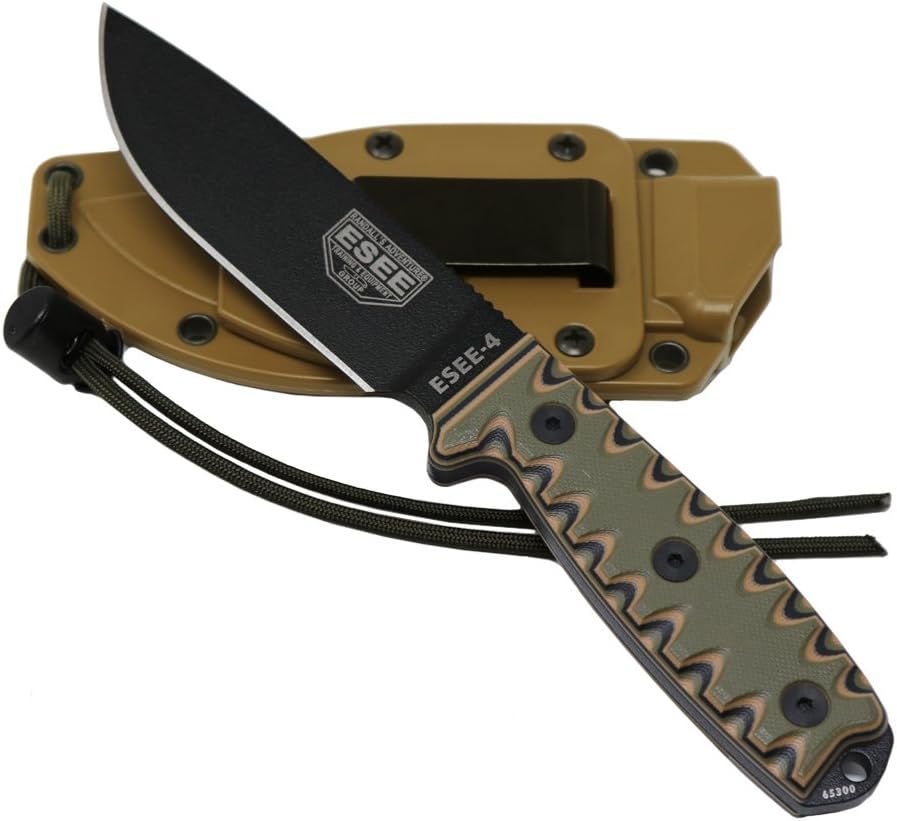
The ESEE-4 takes a different approach. Rather than maximizing lightness, it prioritizes durability, full-tang construction, controllability, and long-term field use.
The standard ESEE-4 uses 1095 high-carbon steel and a blade around 4.5 inches long. Recent testing-oriented comparisons rate it highly as a serious all-purpose bushcraft and camping knife, particularly because of its toughness and field-sharpening characteristics.
One of the ESEE-4’s biggest advantages isn’t actually the blade. It’s the company’s famous unconditional lifetime warranty. That adds a layer of confidence for users who intend to put the knife through demanding outdoor work.
However, 1095 carbon steel requires care. Unlike stainless steel, it can develop corrosion when exposed to moisture and then neglected.
Consequently, the ESEE-4 is a knife for someone willing to maintain their equipment.
What Users Appreciate
The recurring theme surrounding ESEE knives is confidence under hard use.
The full-tang structure provides a solid feel, while the contoured handle helps with controlled cutting. At the same time, the relatively moderate blade length makes it less cumbersome than very large survival knives.
Another benefit is sharpening. 1095 isn’t difficult to maintain with appropriate equipment, and that can be a genuine advantage during longer trips.
On the other hand, it’s heavier than minimalist backpacking knives. Therefore, someone counting every ounce may find it excessive.
Key Features
- Approximately 4.5-inch blade
- 1095 carbon steel
- Full tang
- Contoured handle
- Polymer sheath
- Lifetime warranty
Pros
+ Extremely durable construction
+ Full tang
+ Easy field maintenance
+ Excellent grip
+ Strong warranty
+ Good all-purpose blade size
Cons
− Carbon steel requires maintenance
− Heavier than minimalist options
− More expensive than basic camp knives
Best suited to: Experienced campers, bushcrafters and users who prioritize durability over minimum weight.
4. Gerber StrongArm — Best Rugged Camping Knife
Rating Score: 9.0/10
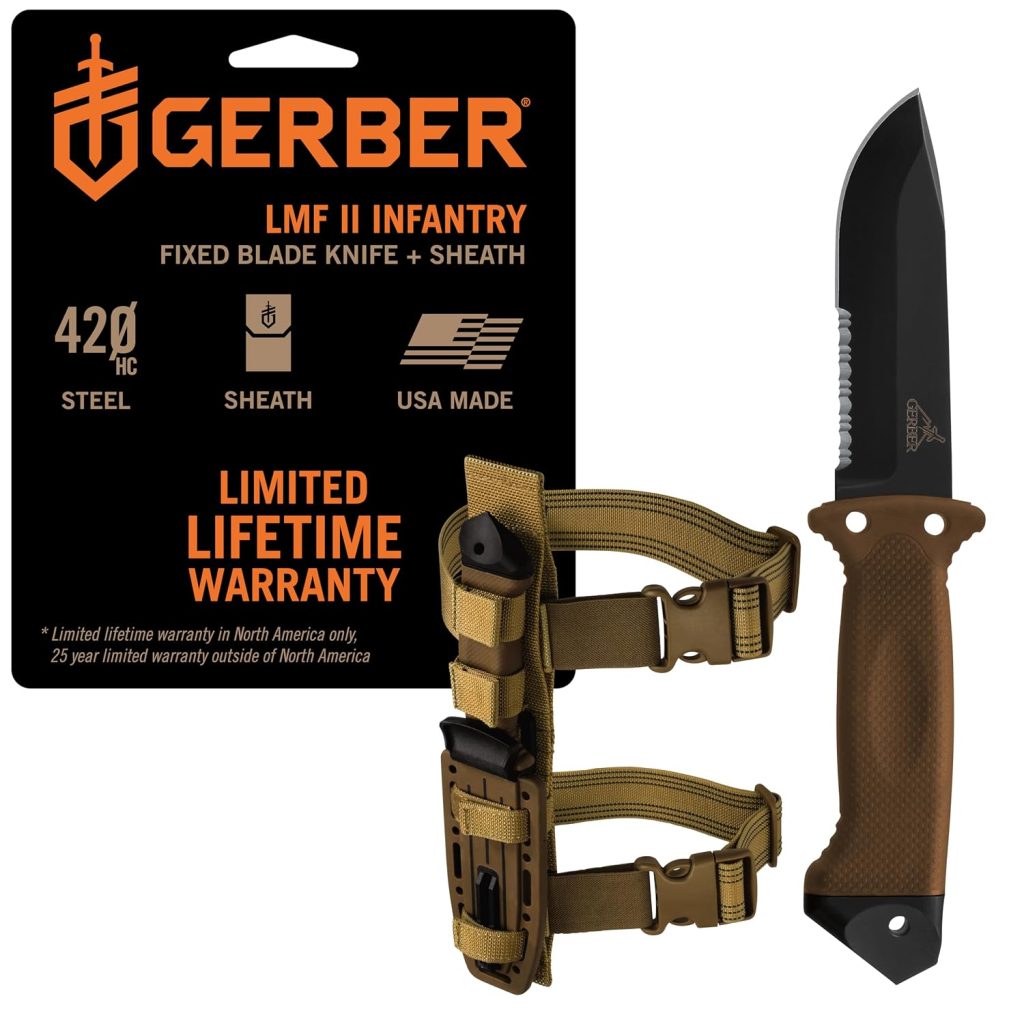
The Gerber StrongArm is designed around rugged outdoor use. Its approximately 4.8-inch 420HC stainless-steel blade, full-tang construction, rubberized grip, and modular sheath make it an interesting middle-ground option.
Recent outdoor knife comparisons consistently identify the StrongArm as a capable mid-priced full-tang outdoor tool. Its stainless steel is particularly practical for users who camp in damp conditions because corrosion resistance reduces maintenance demands compared with ordinary carbon steel.
The handle is one of its defining characteristics. The textured rubberized grip is designed to remain secure in wet conditions, and the pommel adds another functional element to the design.
User Experience
The StrongArm feels more substantial than the Companion. That’s good news if you like a sturdy knife, although it isn’t necessarily ideal for someone trying to keep a backpack ultralight.
The 420HC steel also reflects a sensible compromise. It isn’t positioned as an exotic super-steel, but it is practical, corrosion-resistant and relatively straightforward to sharpen.
That makes the StrongArm particularly attractive for users who don’t want to constantly worry about drying and oiling a carbon-steel blade.
Its modular sheath is another advantage. The design supports multiple carry configurations, giving users more flexibility than a simple belt sheath.
Key Features
- Approximately 4.8-inch blade
- 420HC stainless steel
- Full-tang construction
- Rubberized grip
- Modular sheath
- Multiple carry configurations
Pros
+ Full tang
+ Strong grip
+ Stainless steel
+ Rugged construction
+ Flexible sheath
+ Good general outdoor capability
Cons
− Heavier than minimalist knives
− 420HC has moderate edge retention
− Bulky for ultralight backpacking
Best suited to: General outdoor work, car camping and users wanting a rugged full-tang knife.
5. Benchmade Bugout — Best Lightweight Camping Knife
Rating Score: 8.9/10
The Benchmade Bugout is the odd one out in this comparison, and that’s precisely why it’s worth including.
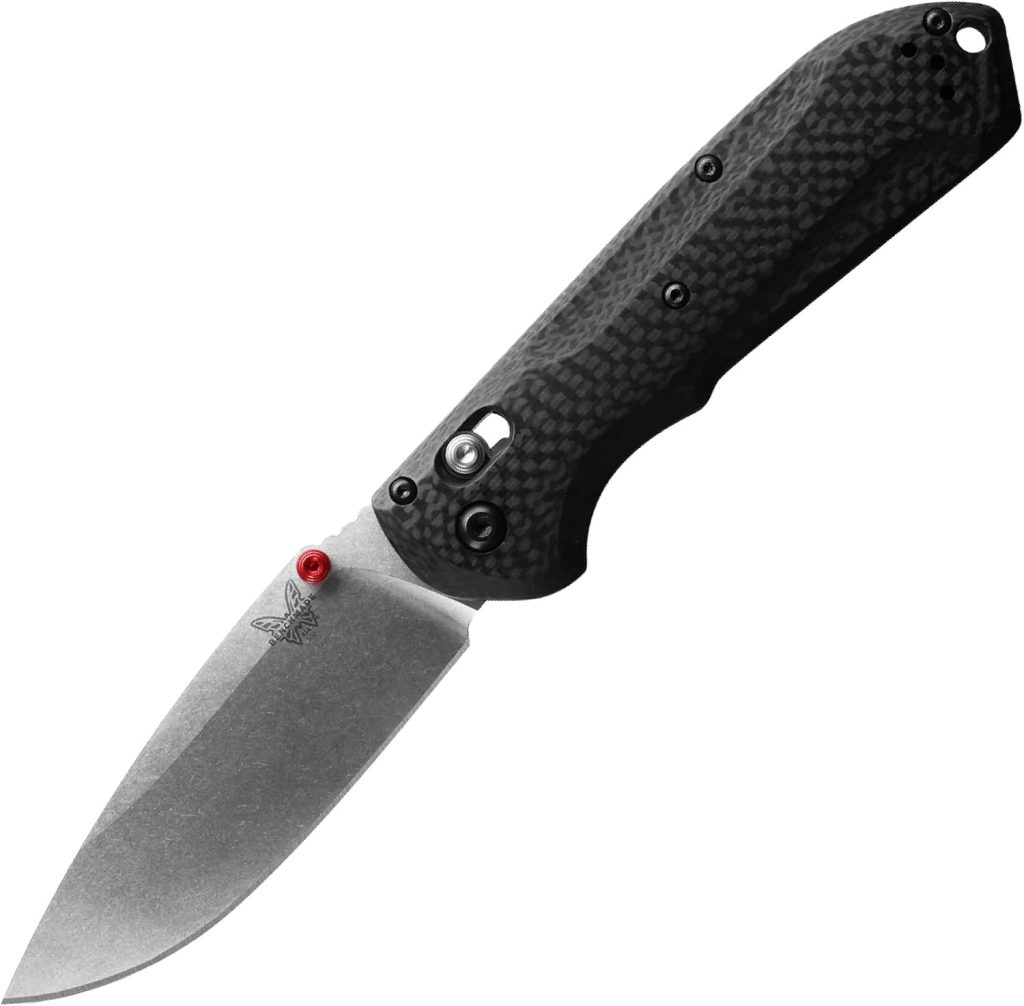
Unlike the four fixed-blade designs, the Bugout is a folding knife built around minimal weight. Outdoor Life measured the model at only 1.9 ounces, making it dramatically lighter than the fixed-blade knives in this comparison. It uses a 3.24-inch CPM-S30V stainless-steel blade and an Axis lock.
Why does that matter?
Because backpackers obsess over weight for good reason. Saving several ounces here and there can make a noticeable difference when you’re carrying everything for multiple days.
The Bugout therefore excels at lightweight tasks such as food preparation, cord cutting, packaging and small campsite chores.
It isn’t, however, a replacement for a heavy-duty fixed blade.
User Experience
The biggest attraction is obvious the moment you pick it up: it’s incredibly light.
The knife practically disappears into a pocket or pack. The CPM-S30V steel provides good edge retention and corrosion resistance, while Benchmade’s LifeSharp service is an additional maintenance benefit. Outdoor Life specifically praised its low weight, compactness and stainless-steel performance.
The compromise is the handle. Outdoor Life notes that the Grivory handle isn’t the most comfortable despite offering useful traction.
Therefore, the Bugout is best considered a lightweight camp utility knife rather than a heavy-duty wood-processing tool.
Key Features
- 3.24-inch blade
- CPM-S30V stainless steel
- Folding design
- Axis lock
- Grivory handle
- Approximately 1.9-ounce measured weight
Pros
+ Exceptionally lightweight
+ Compact
+ Excellent corrosion resistance
+ Good edge retention
+ Convenient pocket carry
+ Excellent backpacking option
Cons
− Not a heavy-duty fixed blade
− Smaller cutting area
− Handle isn’t ideal for prolonged hard work
− Premium price category
Best suited to: Ultralight backpacking and campers who prioritize minimum carry weight.
Which Camping Knife Is Best for Different Campers?
Choosing a camping knife becomes much easier once you stop asking, “Which knife is the strongest?” and instead ask, “What will I actually do with it?”
Weekend Camper
The Morakniv Companion is the sensible choice for ordinary camp chores.
Bushcraft Camper
The Morakniv Garberg provides the additional full-tang construction and outdoor-oriented design that makes sense for more demanding use.
Heavy-Duty User
The ESEE-4 is the stronger candidate when durability and serviceability are more important than saving ounces.
Wet-Climate Camper
A stainless-steel model such as the Companion or StrongArm can reduce corrosion concerns.
Ultralight Backpacker
The Benchmade Bugout is dramatically lighter than the fixed-blade options.
How to Choose a Camping Knife
Blade Steel
Blade steel affects three major characteristics: edge retention, toughness and corrosion resistance.
For example, 1095 carbon steel is popular because it’s tough and relatively easy to sharpen. However, it needs more corrosion care.
Conversely, stainless steels such as 12C27 and 420HC are attractive for campers who expect wet conditions or don’t want to maintain a carbon-steel blade constantly.
Premium steels such as S30V can provide excellent edge retention and corrosion resistance, although sharpening and cost can be different from simpler steels.
Therefore, don’t automatically assume that “premium steel” means “best camping knife.” The right steel is the one that matches your maintenance habits.
Fixed Blade vs Folding Camping Knife
A fixed blade has fewer moving parts and is generally easier to clean and inspect.
A folding knife, however, has an enormous portability advantage.
For backpackers, that distinction can be decisive. The Bugout’s 1.9-ounce measured weight illustrates just how much lighter a folding design can be.
For heavier camp chores, meanwhile, a fixed blade is generally the more appropriate tool.
Blade Length
A blade around four inches is an excellent general-purpose size for camping.
Why?
Because it’s large enough for food preparation and carving without becoming unnecessarily cumbersome.
Longer blades can provide additional leverage and cutting area, but they also increase weight and bulk. Consequently, bigger isn’t automatically better.
Camping Knife Safety
A good camping knife should be treated as a cutting tool, not a toy.
Always keep the blade pointed away from yourself and others, use a stable cutting surface, and avoid cutting toward your supporting hand. When the knife isn’t being used, secure it in an appropriate sheath or closed position.
Furthermore, never use a knife as a substitute for equipment designed for a different task. Prying, throwing, striking inappropriate materials, or using a blade beyond its intended purpose can cause damage or injury.
Before carrying a knife outdoors, check the laws that apply to the specific location, campground, park, or jurisdiction. Rules can differ substantially between jurisdictions and between fixed and folding knives.
Frequently Asked Questions
What is the best camping knife for most people?
For general campsite chores, the Morakniv Companion is the strongest all-around choice in this comparison. It’s light, straightforward, easy to maintain, and suitable for food preparation, carving and ordinary camp tasks.
Is a fixed-blade camping knife better than a folding knife?
Not universally. A fixed blade is generally preferable for demanding outdoor work, while a folding knife is usually more convenient when minimizing size and weight matters. Consequently, backpackers may prefer a lightweight folder while bushcraft users may prefer a fixed blade.
Is 1095 steel good for camping?
Yes. 1095 is a popular outdoor steel because it offers good toughness and is relatively easy to sharpen. However, it isn’t stainless, so moisture and neglect can lead to corrosion.
Which camping knife is easiest to maintain?
Stainless-steel options such as the Morakniv Companion and Gerber StrongArm are attractive for users who want relatively simple corrosion maintenance.
Is the Benchmade Bugout suitable for camping?
Yes, particularly for lightweight backpacking. Its approximately 1.9-ounce weight makes it exceptionally easy to carry. However, it shouldn’t be treated as a substitute for a larger fixed blade when heavier outdoor work is required.
What size camping knife should I choose?
For general camp tasks, around four inches of blade is a useful starting point. It provides enough cutting area for food and carving without creating excessive bulk.
Does an expensive camping knife perform better?
Not necessarily. Price can reflect steel quality, manufacturing, warranty, fit and finish, but an expensive knife isn’t automatically better for your particular camping style. The inexpensive Companion, for example, is repeatedly praised for its performance-to-price ratio.
Final Verdict
There isn’t one perfect camping knife for every outdoor enthusiast.
Instead, there are several excellent designs aimed at different priorities.
Morakniv Companion is the standout general camp tool. It keeps things simple, light and affordable.
Morakniv Garberg is the logical upgrade when full-tang construction becomes important.
ESEE-4 is the hard-use choice for campers who value toughness, field maintenance and a strong warranty.
Gerber StrongArm provides a rugged stainless-steel alternative with a versatile carry system.
Finally, Benchmade Bugout is the specialist option for backpackers who want to minimize weight without giving up a quality blade.
Final Editorial Scores
| Rank | Model | Score | Best For |
| 🥇 | Morakniv Companion | 9.3/10 | Everyday camping |
| 🥈 | ESEE-4 | 9.4/10 | Heavy-duty use |
| 🥉 | Morakniv Garberg | 9.2/10 | Bushcraft |
| 4 | Gerber StrongArm | 9.0/10 | Rugged versatility |
| 5 | Benchmade Bugout | 8.9/10 | Ultralight backpacking |
The scores aren’t Amazon star ratings; they’re editorial scores based on suitability for camping, construction, portability, maintenance, versatility and available independent testing. Publicly indexed sources also show that prices can move substantially, so any price or availability claim should be checked directly before making a purchase.
Most importantly, choose the tool that matches your trip. A lightweight knife is wonderful on a ten-mile backpacking day, while a robust fixed blade may make more sense at a base camp. In the end, the best camping knife isn’t the biggest or most expensive one—it’s the one whose size, steel, weight and construction fit the work you’re actually going to do.