
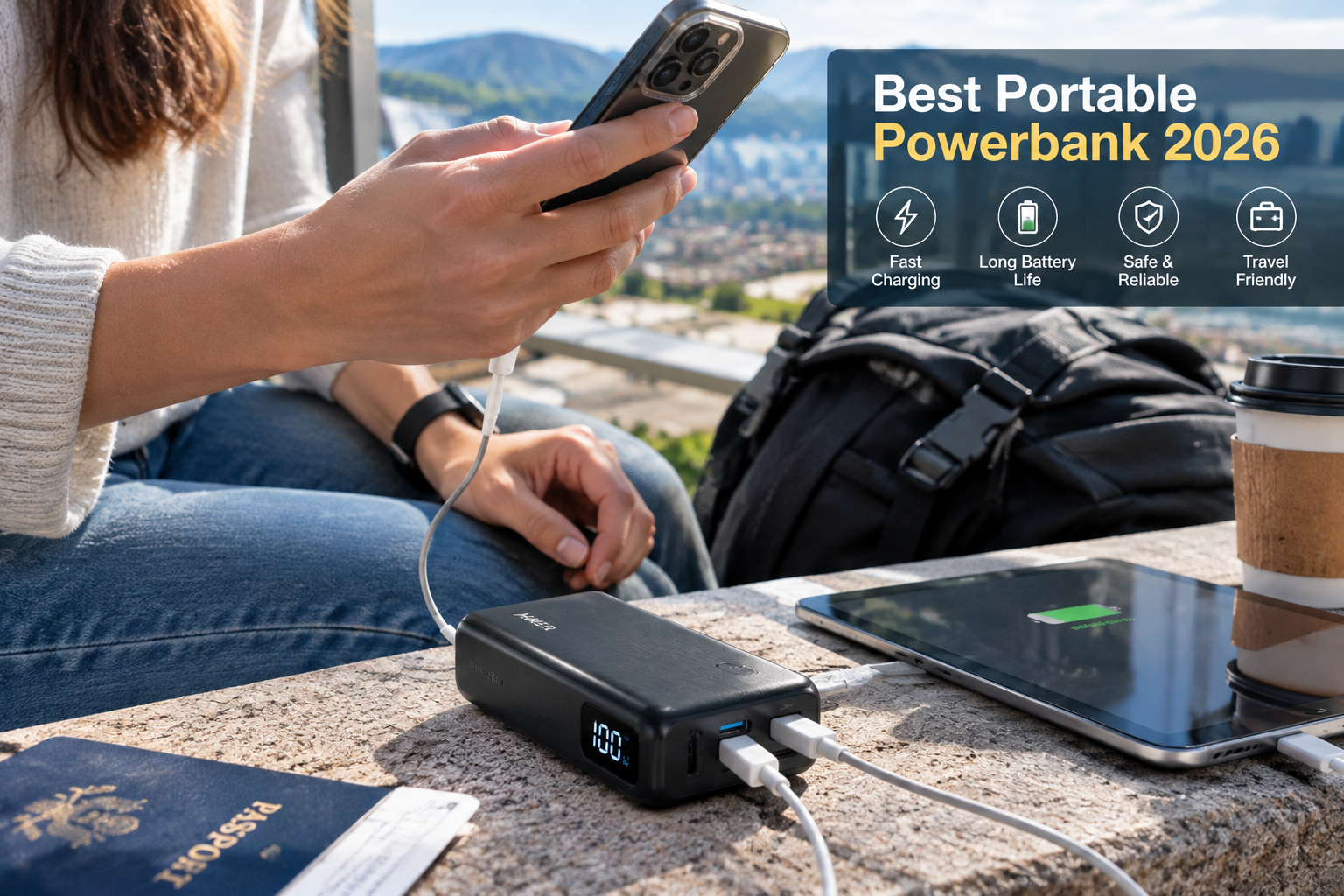
Best Portable Powerbank 2026: 5 Top Picks
What Should You Buy?
A dependable portable power bank is one of those gadgets you may overlook until your phone battery plummets to 3% while you’re out and about. Whether commuting, traveling abroad, attending lectures, or working from a distance, a top-notch battery pack can truly be a game changer.
Yet, not every portable charger is tailored for the same purpose. Some are small enough to fit in a jacket pocket, while others are built to power laptops and multiple devices simultaneously. At the same time, magnetic wireless options provide convenience for compatible smartphones, although they don’t always offer the same efficacy as a wired connection.
In this roundup, the five items were selected to address various priorities: high output, laptop compatibility, cost-effectiveness, magnetic charging, and everyday portability. The selection is based on the latest 2026 purchasing guides and published product details. This is a well-researched editorial comparison, not a guarantee that each model was personally assessed or that current Amazon reviews have been independently verified.
What Makes a Portable Powerbank Worth Buying?
The ultimate portable power bank isn’t always the biggest or the priciest. It should provide sufficient usable energy for your gadgets, recharge them at a decent speed, and stay easy to transport.
Battery capacity: How much energy do you require?
Capacity is often highlighted in milliamp-hours (mAh). A 10,000mAh power bank is typically enough for refreshing a smartphone throughout a hectic day. A 20,000mAh variant supplies more backup for extended journeys or multiple gadgets, though it generally is bulkier and heavier.
It’s important to note that the capacity marked on the exterior doesn’t equate to an equal amount of energy delivered to your phone. Energy losses occur due to voltage conversion, heat, cable quality, and charging scenarios. Consequently, actual recharge metrics vary based on the phone, usage, and power bank.
Output wattage: Why is it crucial?
Wattage influences how rapidly a compatible gadget can recharge. A handy phone-centric charger might supply around 20–30W, while models intended for laptops can offer 65W, 100W, or even more via USB-C PD.
Higher wattage doesn’t inherently guarantee quicker charging for all devices. Your phone or laptop must be compatible with the appropriate charging protocol, along with the cable and port. For instance, a 100W power bank won’t make a phone charge at 100W if the phone can only handle a lesser rate.
Ports, cables, and practicality
Having multiple ports enables you to power a phone, earbuds, tablet, or laptop from one battery. However, the maximum output might be divided when several devices are connected. Review the specifications for each port if charging multiple devices is a priority.
Integrated cables minimize the chance of forgetting a cable, while magnetic wireless charging declutters cable mess. On the flip side, both features might involve compromises: integrated cables may be inconvenient to replace if damaged, and wireless charging typically generates more heat and wastes more energy than wired charging.
1. Anker Prime Power Bank (26K, 300W) — Best Premium Portable Powerbank
Editorial rating: 4.8/5
Best for: Power users, laptop owners, and people charging several devices.

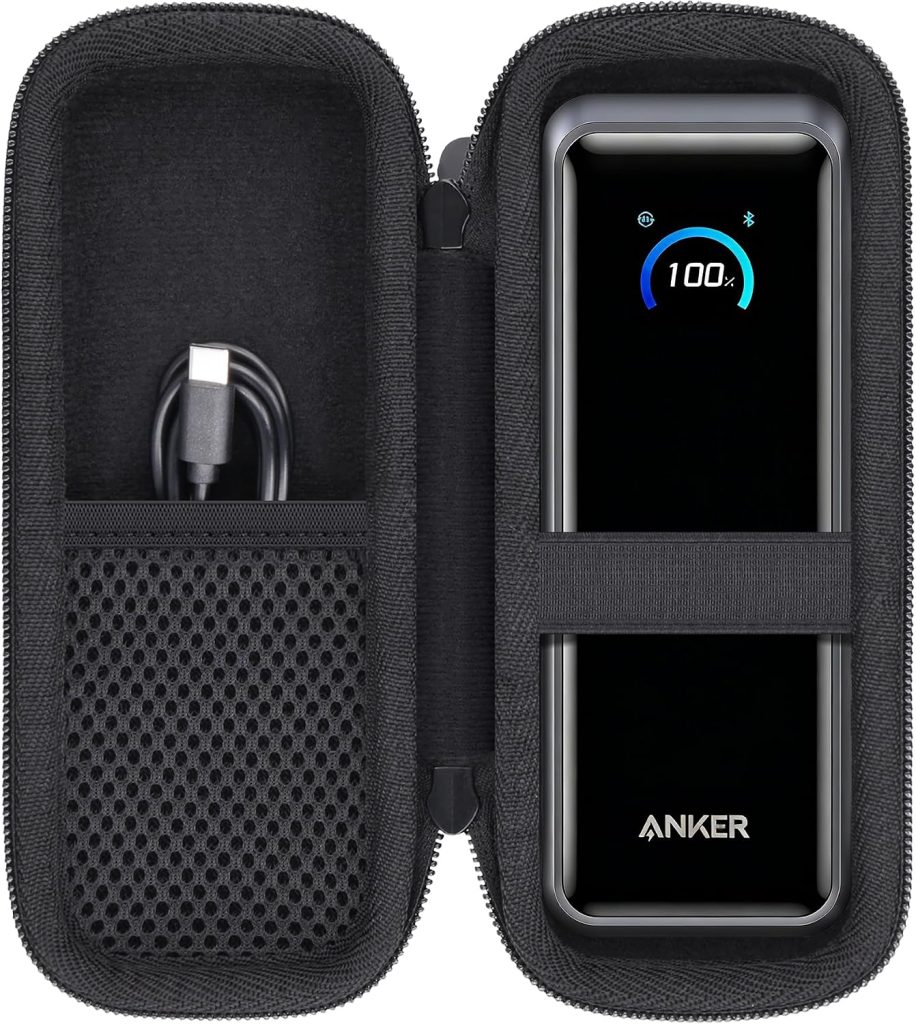
The Anker Prime Power Bank is the top-tier option for individuals who require significantly more than a mere emergency phone charge. Its impressive output specifications and substantial battery capacity make it ideal for demanding mobile configurations, encompassing a laptop, smartphone, tablet, and other devices. Popular Science featured the 26K, 300W Prime model among its top portable charging selections in its October 2026 guide, emphasizing its ability to charge multiple devices simultaneously and its rapid recharging assertions. Actual efficiency will hinge on the devices connected and the charging arrangement.
Product Overview
What sets this portable powerbank apart is its emphasis on power delivery rather than merely fitting into the tiniest pocket. With a rated capacity of around 26,250mAh and a claimed total output of up to 300W, it caters to users who transport several power-hungry gadgets. It can be especially beneficial for remote workers, content creators, and frequent travelers who may not always have access to a power outlet.
The digital display stands out as another practical benefit. Rather than depending solely on a few indicator lights, a comprehensive display enables you to track the remaining charge and power delivery efficiently. That added information is useful when determining whether to charge a laptop immediately or conserve energy for a phone later.
Naturally, high-end performance comes with a price. A large, high-output battery is bulkier and costlier than a basic phone charger. It’s also overkill for anyone who just needs sufficient energy to get through a brief commute. Prior to purchasing, verify the specific model and its supported output on the manufacturer’s specification page and the real-time Amazon listing.
Key Features
- Approximately 26,250mAh rated capacity.
- Advertised total output of up to 300W.
- Designed to charge multiple compatible devices.
- Digital display for monitoring charging information.
- USB-C-based high-power charging, with exact port limits dependent on model specifications.
Pros
- Excellent option for laptop and multi-device charging.
- High power output offers flexibility for demanding equipment.
- Display provides more useful information than simple status lights.
- Suitable for people who want one powerful bank instead of several smaller ones.
Cons
- More expensive than everyday phone-focused alternatives.
- Bulkier and heavier than compact 10,000mAh options.
- Maximum output depends on the devices, ports, and charging conditions.
- Overkill for buyers who rarely charge anything beyond a phone.
What should buyers consider in customer reviews?
When examining Amazon feedback, look for comments about sustained laptop charging, recharge speed, display accuracy, weight, and performance when several ports are used. These are more helpful than a vague comment saying the battery is “great.” Check the newest reviews for the exact model, because listings can combine different capacities or product revisions.
Verdict: Choose the Anker Prime if power and versatility matter more than price or pocketability. For a basic emergency charger, a smaller bank will usually be better value.
2. UGREEN Nexode 20,000mAh 130W — Best Portable Powerbank for Travel and Laptops
Editorial rating: 4.7/5
Best for: Frequent travelers, hybrid workers, and USB-C laptop users.
Product Description
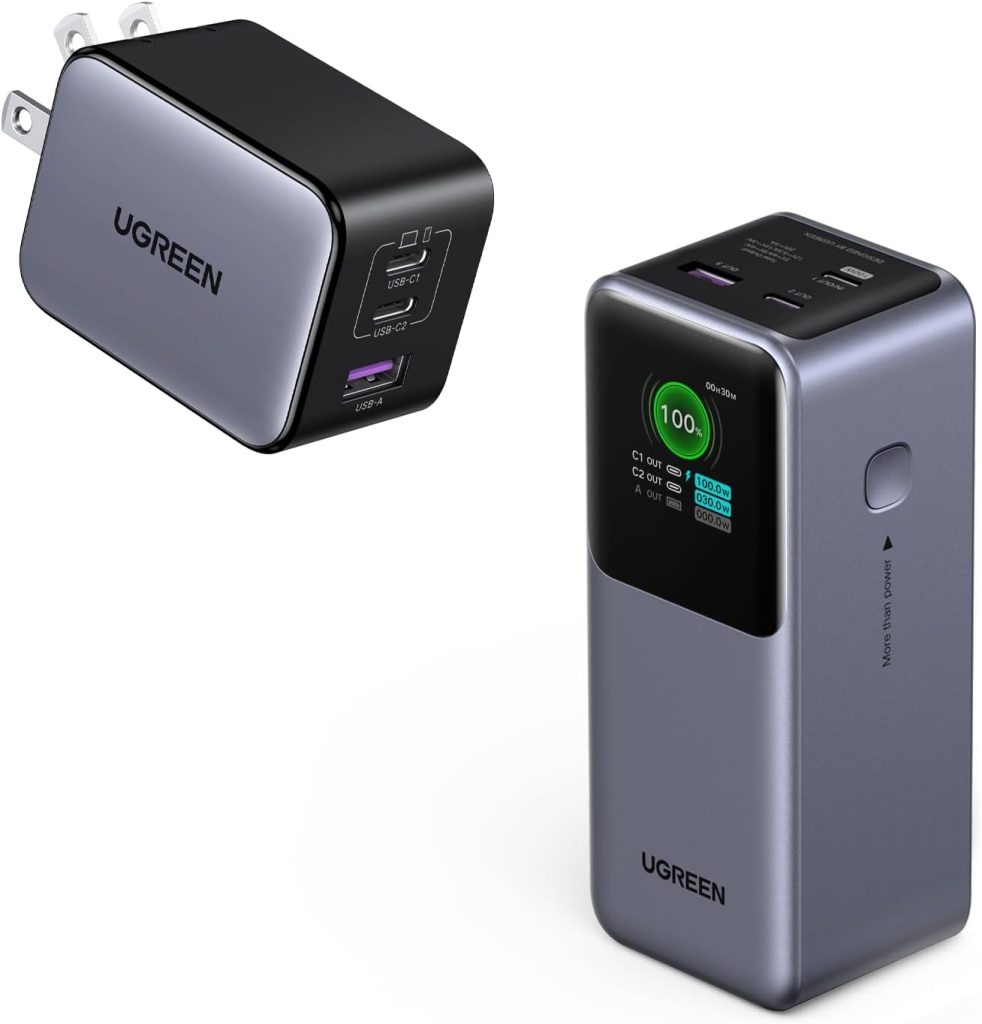
A mobile power bank must find the sweet spot between capacity and portability, and the UGREEN Nexode 20,000mAh 130W is crafted with that equilibrium in mind. Its claimed 20,000mAh capacity provides more backup than an average pocket-sized charger, while its elevated-output USB-C charging makes it a practical choice for compatible laptops and tablets.
For individuals who work in coffee shops, embark on lengthy train rides, or spend prolonged periods away from a workstation, this type of power bank can offer significant versatility. Instead of lugging around a dedicated phone battery and a separate laptop battery, you could potentially rely on one device for multiple gadgets. However, the compatibility with laptops hinges on the laptop’s charging needs and the specifications of the power bank’s ports.
UGREEN features a range of Nexode models with similar names but varying capacities and wattage levels. This detail is crucial: don’t presume that every Nexode bank delivers the same output, port setup, or integrated cable. Make sure to verify the specific 20,000mAh, 130W listing prior to purchase.
The primary trade-off is the size. A 20,000mAh unit is generally not as pocket-friendly as a smaller 5,000mAh or 10,000mAh charger. However, for numerous travelers, the extra capacity justifies the added heft. If you’re predominantly charging a phone during quick errands, a more compact option may be easier to carry on a daily basis.
Key Features
- 20,000mAh advertised capacity.
- Up to 130W output for compatible devices, according to the model specification.
- USB-C charging suited to compatible laptops and tablets.
- Multiple-device charging capability, subject to shared-output limits.
- A practical middle ground between a pocket charger and a premium high-capacity bank.
Pros
- Strong output potential for compatible USB-C laptops.
- Useful capacity for travel and workdays away from a wall outlet.
- More versatile than a phone-only charging accessory.
- Can reduce the need to carry multiple battery packs.
Cons
- Larger than a compact everyday phone charger.
- Laptop charging speed varies by model and power requirements.
- Simultaneous charging can reduce available output per port.
- Nexode product names can be confusing; the exact model needs checking.
What insights should Amazon users’ evaluations uncover?
Pay attention to verified-purchase remarks concerning actual laptop compatibility, how long it takes for the bank to recharge, overheating during extensive use, and clarity of the display or port labels. For those traveling, consider the weight and whether the unit comfortably fits in your bag.
Conclusion: The UGREEN Nexode stands out as a compelling option for travelers seeking a portable power bank that packs more punch than a standard phone charger without venturing into the pricier premium range.
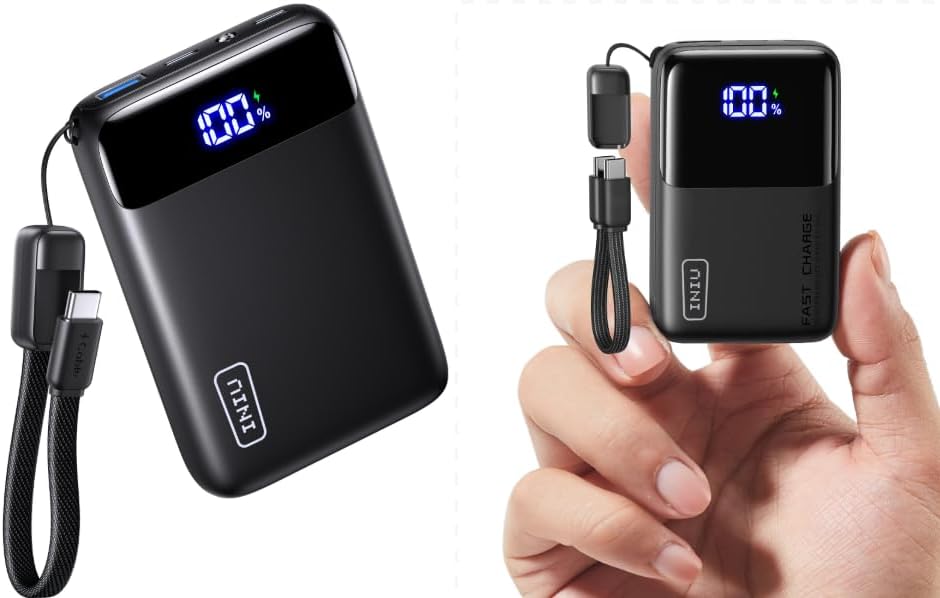
3. INIU 20,000mAh 45W Portable Charger — Best Budget-Friendly Portable Powerbank
Editorial rating: 4.5/5
Best for: Students, commuters, and budget-conscious smartphone users.
Product Overview
Not everyone requires a battery pack capable of powering a high-performance laptop. Sometimes, simplicity is key: keep a phone, wireless earbuds, or tablet alive throughout a lengthy day without breaking the bank. This is where the INIU 20,000mAh 45W portable charger comes into play.
Its stated capacity offers ample reserve for standard phone-charging demands, while the 45W output can facilitate faster charging for compatible phones and some smaller USB-C gadgets. It may also extend limited charging capabilities to select laptops, but it’s wise to confirm the laptop’s minimum input needs rather than assume universal applicability.
INIU has marketed several variations of portable chargers, including options with diverse output ratings and integrated cables. Thus, consider “20,000mAh 45W” as the primary model designation and verify the precise specifications on the product page. If a built-in cable is part of the offering, check its supported output and whether it is replaceable or serviceable in case of damage.
The attraction is clear: a reasonable amount of capacity without the premium cost associated with high-output laptop banks. For students shuttling between classes, commuters utilizing public transport, and travelers mainly in need of phone power, this can represent the ideal compromise. However, don’t anticipate the same charging versatility as with a model exceeding 100W.
Key Features
- 20,000mAh advertised capacity.
- Up to 45W output on the specified model.
- Intended for phones, tablets, and compatible USB-C devices.
- Multiple charging options may be available depending on the exact version.
- A budget-oriented alternative to premium laptop power banks.
Pros
- Useful capacity for extended phone use.
- More affordable class of charger than premium high-wattage models.
- 45W can be sufficient for many phones and smaller devices.
- A sensible option for commuting, school, and everyday travel.
Cons
- Lower output than laptop-focused premium models.
- Large capacity can make it less pocketable.
- Exact port layout and cable features vary across versions.
- Not ideal for demanding laptops that require higher USB-C input.
How should you interpret Amazon customer feedback?
Seek out recurrent remarks regarding charging reliability, effective capacity in daily usage, sturdiness, and how the unit holds up after several months. A handful of enthusiastic reviews do not suffice to validate long-term reliability. Recent critical feedback can be particularly beneficial if it highlights a common issue with a specific version.
Conclusion: If an affordable portable power bank for everyday gadgets is what you seek, rather than a high-end laptop setup, the INIU 20,000mAh 45W is certainly worth comparing with similarly priced alternatives.
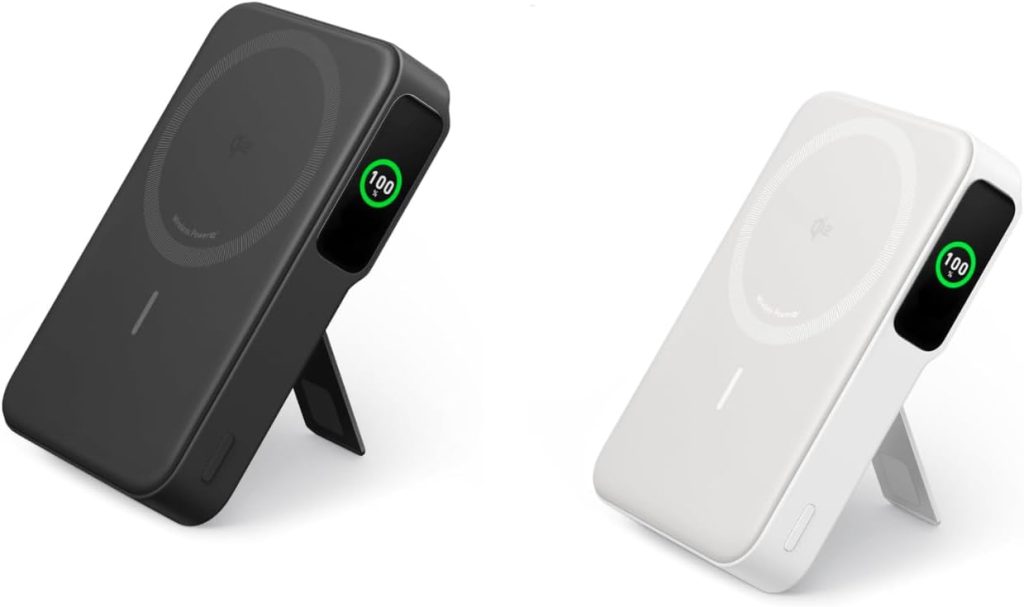
4. Anker MagGo 10,000mAh — Best Portable Powerbank for Magnetic Wireless Charging
Editorial rating: 4.6/5
Best for: Compatible iPhone users who value cable-free convenience.
Product Description
Some individuals prefer not to lug around a charging cable whenever they step out. For iPhones that are compatible, the Anker MagGo series provides an alternative solution: a magnetic portable power bank that easily attaches to the back of the device and enables wireless charging.
This configuration is handy when you’re using your phone for navigation, checking notifications while on the move, or snapping pictures during the day. You can maintain the phone’s charge without needing to plug in a cable to its port. Depending on the specific model, Qi2 compatibility and magnetic alignment can enhance the wireless charging experience for supported devices.
Nevertheless, wireless charging isn’t a flawless solution. It generally produces increased heat and results in more energy loss compared to a wired connection. Factors such as the phone’s case, magnetic alignment, ambient temperature, and charging standard can all affect performance. If achieving maximum efficiency or the quickest charge is your top priority, a wired USB-C power bank is typically the more logical option.
Exercise caution when shopping: the Anker MagGo collection features various versions with differing capacities, wireless standards, stands, and charging speeds. Ensure that the listing corresponds to the 10,000mAh model you want to buy and that your phone is equipped for the advertised wireless capabilities. Users of Android devices should check for magnetic compatibility instead of assuming that every phone will attach securely.
Key Features
- 10,000mAh advertised capacity for the selected model.
- Magnetic wireless charging on compatible phones.
- Convenient cable-free phone charging.
- Portable format intended for everyday carry.
- Exact wireless charging rate depends on model and phone compatibility.
Pros
- Convenient for compatible iPhones.
- No charging cable is required for supported wireless use.
- Useful when using the phone while traveling or taking photos.
- Compact capacity for daily top-ups.
Cons
- Wireless charging is less energy-efficient than wired charging.
- Heat can affect charging performance.
- Magnetic attachment and charging speed depend on phone and case compatibility.
- Usually less versatile for laptops and other high-power devices.
What should Amazon reviewers help you confirm?
Read feedback about magnetic grip, wireless charging consistency, temperature, and whether the power bank works with the phone and case you own. Also check whether buyers are discussing the same MagGo version; comments about a different model may not apply.
Verdict: The Anker MagGo is worth considering when convenience matters more than maximum charging efficiency. If you use a compatible iPhone and dislike carrying cables, it can be a practical everyday companion.
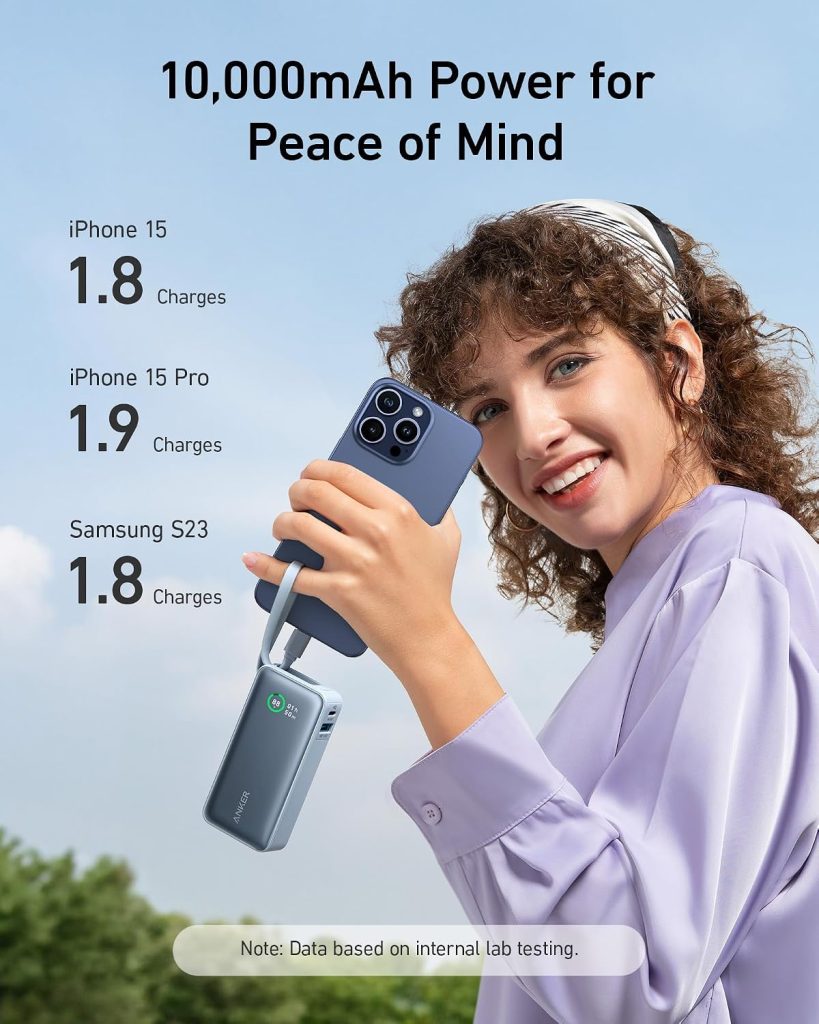
5. Anker Nano 10,000mAh 30W — Best Portable Powerbank for Everyday Carry
Editorial rating: 4.5/5
Best for: Daily commuters, students, and smartphone users who want a manageable charger.
Product Description
The perfect travel-friendly power bank is one you actually remember to take along. A sleek 10,000mAh option like the Anker Nano 30W is crafted for daily use rather than for extensive laptop charging. It offers a handy battery backup without the cumbersome size of a bulkier 20,000mAh alternative.
With a claimed power output of up to 30W for this particular model, it efficiently charges numerous compatible smartphones at an impressive rate. It’s also capable of recharging earbuds, smaller tablets, and various USB-powered gadgets. However, the precise charging speed will depend on the supported protocol of your device, as well as the cable and port utilized.
This more compact power bank is especially attractive for brief outings, office travels, and days spent exploring a city. It easily fits into a compact bag or backpack, providing an extra layer of security when battery life dwindles. On the other hand, for regular laptop users, the lower capacity and output might pose limitations. A larger power bank with elevated USB-C PD output is more suitable if you intend to charge a laptop regularly.
As with other Anker product lines, it’s essential to verify the specific Nano variant. Certain models feature built-in cables or varied port configurations, and specifications can change between versions. Be sure to check the capacity, maximum output, and included accessories on the current Amazon listing.
Key Features
- 10,000mAh advertised capacity.
- Up to 30W output on the specified version.
- Compact format for everyday phone charging.
- Suitable for compatible smartphones and smaller USB devices.
- Different Nano variants may offer different cable and port features.
Pros
- Convenient size for everyday carry.
- Useful for commuting and short trips.
- 30W output can support fast charging on compatible phones.
- Less bulky than high-capacity laptop power banks.
Cons
- Less energy reserve than 20,000mAh models.
- Not the best option for demanding laptop charging.
- Maximum charging speed depends on device compatibility.
- Model variations require careful checking before ordering.
What should Amazon customers look for?
Prioritize reviews that mention pocketability, charging speed on your specific phone, recharge time for the bank itself, and cable convenience. If you carry a phone all day but rarely use a tablet or laptop, these everyday details matter more than an impressive peak wattage number.
Verdict: For people who want a straightforward portable powerbank for phone charging, the Anker Nano is a sensible compact option to compare with other 10,000mAh chargers.
Portable Powerbank Comparison Table
| Product | Best for | Advertised capacity | Maximum advertised output | Main advantage |
|---|---|---|---|---|
| Anker Prime 26K, 300W | Premium multi-device use | About 26,250mAh | Up to 300W total | High power and display |
| UGREEN Nexode 20K, 130W | Travel and laptops | 20,000mAh | Up to 130W | Laptop-friendly output |
| INIU 20K, 45W | Budget buyers | 20,000mAh | Up to 45W | Practical capacity for the price |
| Anker MagGo 10K | Magnetic wireless charging | 10,000mAh | Model-dependent wireless output | Cable-free convenience |
| Anker Nano 10K, 30W | Everyday carry | 10,000mAh | Up to 30W | Compact design |
Specifications above are based on the identified product variants and published product information. Confirm the precise version, supported protocols, port limits, and current Amazon listing before purchasing. Editorial ratings are comparative assessments for this article, not live Amazon star ratings.
How to Choose the Right Portable Powerbank
1. Match the powerbank to your main device
Start with the device you need to charge most often. If it’s a smartphone, a 10,000mAh charger may be enough for a typical day. If you’re regularly charging several devices or spending long periods away from a wall outlet, consider 20,000mAh or more.
For laptops, capacity is only half the story. Check the USB-C PD wattage your laptop requires and make sure the selected power bank supports it. A high-capacity battery with insufficient output might charge a laptop very slowly or fail to charge it while the laptop is in use.
2. Consider weight and size
More capacity generally means more battery cells, and that usually increases weight. A large bank may be excellent for travel but inconvenient in a pocket. Conversely, a small charger is easy to carry but won’t offer as much energy.
Think about your normal routine. A compact powerbank is often the better everyday choice, while a larger model makes more sense for long trips, laptop work, or multiple users sharing one charger.
3. Check ports and simultaneous output
A charger with several ports can be useful, but maximum output may be shared between connected devices. If you need to charge a laptop and phone at the same time, read the output table in the product specifications. Don’t assume each port can provide the advertised maximum simultaneously.
4. Think about wireless charging
Magnetic wireless charging can be convenient for compatible phones, but wired charging is generally more efficient. If you choose a wireless portable powerbank, verify the charging standard, supported phone models, and case compatibility.
5. Check airline restrictions
Many conventional power banks are designed to fall below the common 100Wh threshold, but capacity in mAh alone doesn’t tell the whole story because the voltage rating matters. Airline and country rules can vary, and policies may change. Before flying, confirm the watt-hour rating printed on the battery and check the airline’s current rules. Power banks are generally required to be carried in cabin baggage rather than checked baggage; follow the specific carrier’s instructions.
6. Buy from a trustworthy listing
On Amazon, check who sells and ships the item, whether the model number matches the manufacturer’s product page, and whether the listing has a clear warranty and return policy. Read recent critical reviews alongside positive ones. Pay attention to repeated reports about charging failures, overheating, inaccurate capacity indicators, or problems with customer support.
Frequently Asked Questions
1. What is the best portable powerbank in 2026?
For high-output, multi-device charging, the Anker Prime 26K, 300W is a premium contender. The best choice for you depends on whether you need laptop power, a budget-friendly battery, magnetic wireless charging, or a compact phone charger.
2. Is a 10,000mAh portable powerbank enough?
For many people, yes. A 10,000mAh model can provide a useful phone recharge reserve for a day out. The exact number of charges depends on phone battery size, energy losses, and how you use the device while charging.
3. Is 20,000mAh better than 10,000mAh?
A 20,000mAh bank stores more rated energy, so it is generally better for longer trips and charging several devices. However, it is usually larger and heavier. If portability is your priority, 10,000mAh may be the better balance.
4. Can a portable powerbank charge a laptop?
Yes, provided the power bank supports the laptop’s charging standard and sufficient USB-C PD output. Check the laptop’s required wattage and the power bank’s single-port specifications before purchasing.
5. Are wireless power banks worth it?
They can be, particularly for compatible phones and users who want cable-free charging. However, wired charging is generally more efficient, and wireless charging can generate more heat. Choose based on convenience versus efficiency.
6. How do I find the best portable powerbank on Amazon US?
Compare the exact model, recent verified-purchase reviews, current seller, warranty, capacity, and output wattage. Look for consistent patterns across reviews instead of relying on one unusually positive or negative comment. Confirm the current star rating directly on the live listing.
7. Can I take a powerbank on an airplane?
Many power banks can be carried in cabin baggage if they meet the applicable watt-hour limits and airline rules. They are generally not allowed in checked baggage. Check the label on your particular battery and your airline’s latest policy before traveling.
8. How long should a portable powerbank last?
Service life depends on battery chemistry, temperature, charging habits, and build quality. Capacity gradually declines over repeated charging cycles. Avoid excessive heat, use compatible chargers, and follow the manufacturer’s instructions to help preserve battery health.
9. Should I buy the highest-wattage portable powerbank?
Not necessarily. High wattage matters most when charging laptops or several power-hungry devices. For an everyday smartphone, a smaller and less expensive charger may meet your needs perfectly well.
10. Are the ratings in this review current Amazon customer ratings?
No. The scores in this article are editorial assessments for comparing the five options. Amazon ratings, review counts, prices, sellers, and availability change, so check the current US listing before making a purchase.
Final Verdict: Which Portable Powerbank Should You Buy?
The best A portable power bank is designed to accommodate your devices and daily routine without burdening you with excess weight or investing in features you won’t utilize.
-Best premium choice: Anker Prime Power Bank (26K, 300W) for superior multi-device charging capabilities.
-Best for travel and laptops: UGREEN Nexode 20,000mAh 130W for an excellent compromise of capacity and power output.
-For the best budget-friendly option: INIU 20,000mAh 45W for routine charging requirements at a more affordable performance level.
-Best for magnetic wireless charging: Anker MagGo 10,000mAh designed for compatible iPhones.
-Best everyday carry: Anker Nano 10,000mAh 30W for easy phone recharging.
In the end, resist the urge to purchase a portable charger solely based on its impressive capacity metrics. Ensure the wattage aligns with your devices, review user experiences, verify the specific model on Amazon US, and reflect on how much weight you’re prepared to carry. This approach will guarantee you have a power bank that’s truly beneficial rather than just another gadget left behind.